
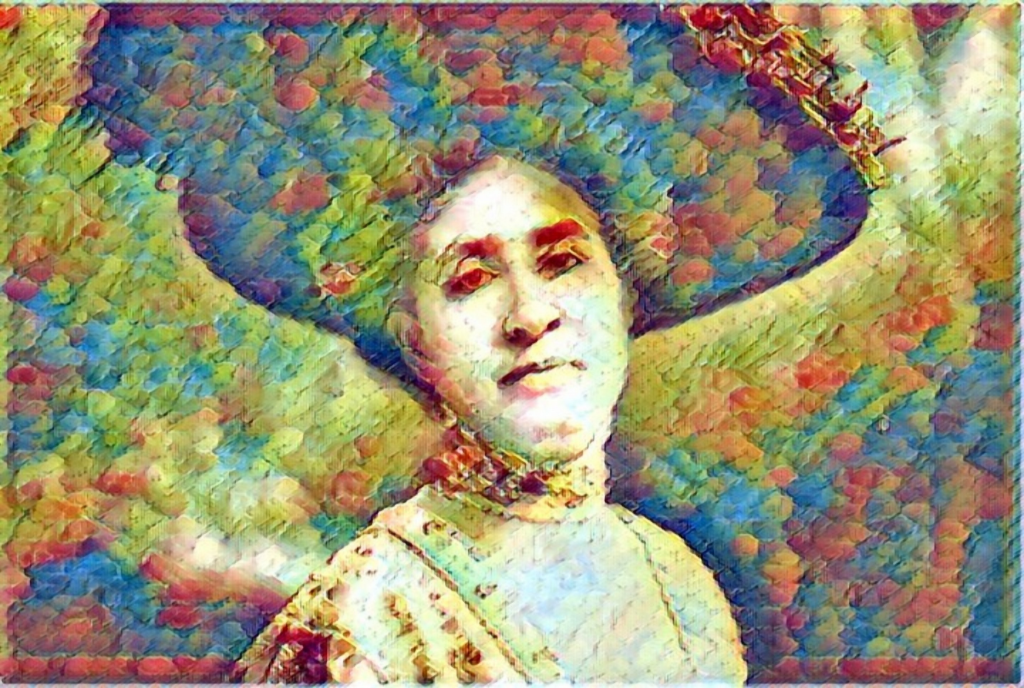
Mary Church Terrell – champion of racial equality and women’s suffrage.
Mary Church Terrell (1863–1954) was born in Memphis, Tennessee, to formerly enslaved parents who became successful business owners. She was an educator, writer, and activist, and when she graduated from Oberlin College in 1884, became one of the first Black women in the United States to earn a college degree.
As a leading advocate for both Black civil rights and women’s suffrage during the late nineteenth and early twentieth centuries, she had a tremendous resume. Mary helped found the National Association of Colored Women and served as its first president, using the organization to promote education, economic opportunity, and racial uplift. She also worked with the National American Woman Suffrage Association and later challenged segregation in Washington, D.C., demonstrating throughout her long life that the struggles for racial equality and women’s rights were inseparable.
Her anti-lynching activism is an important axis of her life’s work alongside women’s rights and education-based racial uplift. A terrible crime propelled her into this arena: the 1892 lynching of her friend Thomas Moss. He was a Black businessman, postal worker, and community leader who co-owned the People’s Grocery, a successful Memphis cooperative store with Calvin McDowell and William “Will” Stewart. The store’s prosperity represented Black economic independence and community self-determination, but it also provoked hostility from nearby white business owners.
In March 1892, after a confrontation at the store, Moss, McDowell, and Stewart were arrested. A white mob removed them from jail on March 9 and murdered them. As has happened again and again throughout our history, there were no consequences for the crime. Moss was also a close friend and the godfather of Ida B. Wells-Barnett’s child, and his murder was the act that propelled her into becoming the great anti-lynching activist of her era.
Over the course of her life, Mary Church Terrell upheld that education, economic advancement, civic participation, and collective organizing could challenge white supremacy; this vision became captured in the National Association of Colored Women’s motto, “Lifting as we climb.” She advocated for Black women’s education and political participation while also speaking publicly against lynching, racial discrimination, and the exclusion of Black women from mainstream suffrage movements. She later became a charter member of the NAACP and continued pressing for voting rights, including picketing the White House with the National Woman’s Party.
After the passage of the Nineteenth Amendment, Terrell did not treat women’s suffrage as the end of the struggle. She turned increasingly toward dismantling segregation in everyday life, documenting discrimination in her 1940 autobiography, A Colored Woman in a White World, and successfully challenging her exclusion from the American Association of University Women in 1948.
Her most dramatic victory came when she was 86: in 1950, she helped organize a test case after Thompson’s Restaurant refused to serve her and her companions because they were Black. Working with pro bono attorneys and the Coordinating Committee for the Enforcement of D.C. Anti-Discrimination Laws, she challenged forgotten Reconstruction-era laws that prohibited racial discrimination in Washington restaurants. In 1953, the Supreme Court unanimously ruled in District of Columbia v. John R. Thompson Co. that those laws remained valid, effectively ending legally sanctioned segregation in the capital’s eating establishments—one year before Brown v. Board of Education.
What I love about her is that she shows us that we can keep fighting as long as we have breath—and will. Terrell’s late-life victory was not a departure from her earlier activism; it was the culmination of a lifelong strategy. Here’s her playbook:
- Build women’s collective power through education, clubs, writing, and public speaking. In her case, she built power for Black women, but these strategies are universal.
- Connect racial justice to women’s suffrage rather than treating them as separate causes. At Brave Sis Project, we contend that racism is the blueprint for all other forms of discrimination. Remember Nazi Germany came to the US to study Jim Crow as part of their planning.
- When needed, shift from persuasion and racial uplift to direct action, including pickets, boycotts, demonstrations, and litigation.
- Use all your tools: education, social position, and public credibility to expose contradictions between American democratic ideals and racial exclusion.
- Keep going. She was in her eighties when she transformed decades of organizing into a precise legal challenge that produced a concrete institutional change.
So, even though this great Foremother died seven-plus decades ago, in 1954, the arc of her life shows us that you fight for what’s right, regardless of the timetable. Her influence endured because she kept adapting her methods—from speeches and associations to lawsuits and public protest—while holding onto the same core demand: Black women deserved full citizenship, dignity, access, and power. Any person who thinks that women, Black women, Brown women, any woman, deserves equal rights and dignity can get behind her example!