
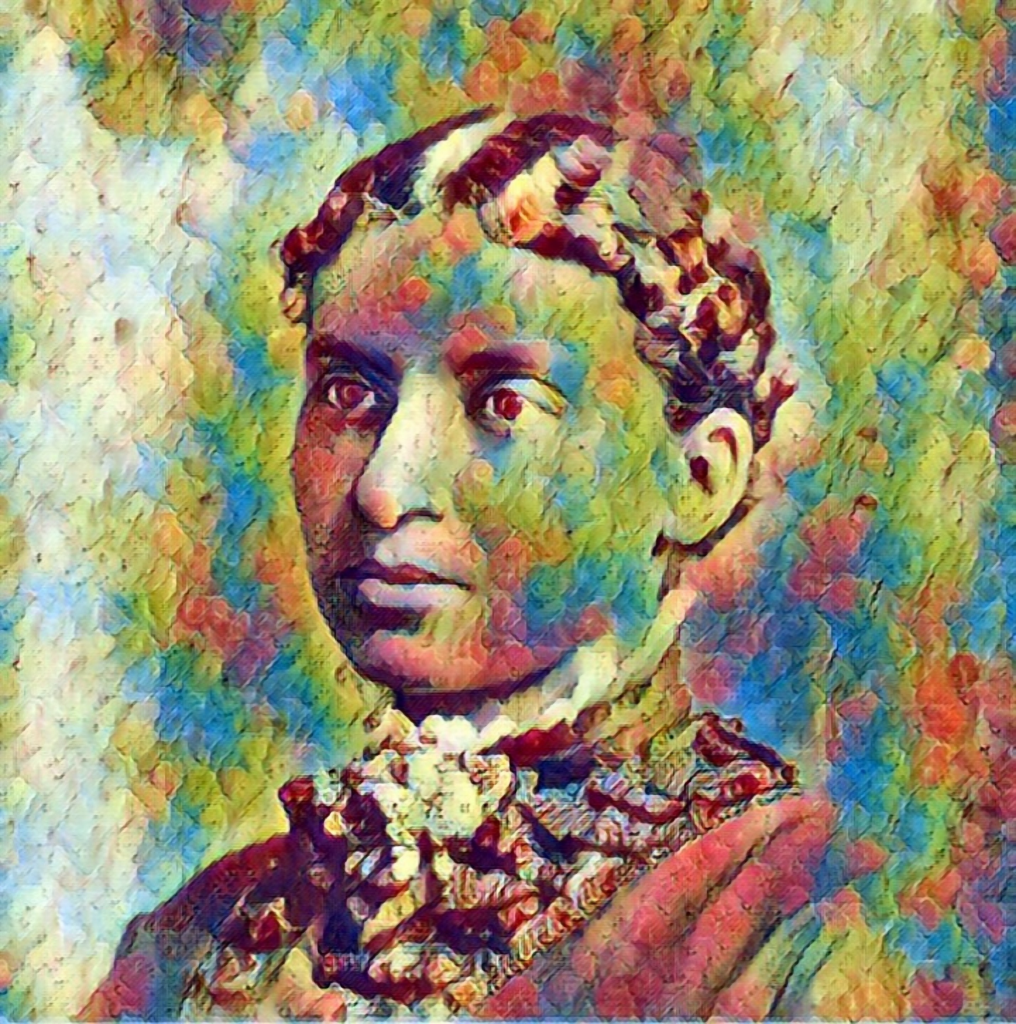
Charlotte Forten Grimké — abolitionist, educator, poet, and diarist.
Charlotte Louise Bridges Forten Grimké (1837–1914) was born free in Philadelphia into the prominent Forten-Purvis family, a Black family deeply involved in abolitionism and civic life. She grew up surrounded by people committed to racial justice, and she carried that legacy into a life of teaching, writing, and activism. A gifted student, she studied in Salem, Massachusetts, where she was often the only Black student in her classes. After graduating from Salem Normal School, she became the first Black teacher in Salem’s public-school system and one of the first Black women to teach white students in Massachusetts.
When Union forces occupied the Sea Islands off South Carolina during the Civil War, Forten joined the Port Royal Experiment, traveling in 1862 to teach formerly enslaved people on St. Helena Island. She was the first Black teacher to arrive there and understood education not simply as literacy, but as an essential practice of freedom, dignity, and self-determination. Her time on the islands was marked by demanding work and chronic ill health (tuberculosis), yet it produced some of her most enduring writing: the essays “Life on the Sea Islands,” published in The Atlantic Monthly in 1864. (“Life on the Sea Islands,” Part I — and Part II.)
Forten began keeping journals as a teenager, and across decades she recorded her intellectual life, encounters with racism, abolitionist commitments, grief, faith, poetry, and observations of the Civil War era. Published after her death, these diaries became a rare and invaluable record of a free, educated Black woman’s life in nineteenth-century America. Her writing also preserved the spirituals she heard from Sea Island communities, making her an important early documentarian of Black cultural expression.
After the war, Forten continued to work in education and public service, including recruiting teachers for the U.S. Treasury Department and later serving as a Treasury clerk in Washington, D.C. In 1878, she married Reverend Francis J. Grimké, a formerly enslaved man and prominent Presbyterian minister. She remained active in civil-rights and women’s-rights work throughout her life, including helping to found the National Association of Colored Women in 1896.
Charlotte Forten Grimké died in Washington, D.C., in 1914, leaving a legacy that joins political conviction with the quieter, radical labor of teaching, observing, writing, and telling the truth about Black life. Hers is not a household name for many, but what she models to me is compassion and care for her people. She did not visit the Sea Islands as a “white savior” nor as an anthropologist with the “white gaze” (though the Atlantic at that time was likely more voyeur than protector in its editorial ken!) but she made these commitments out of a true love of her people and dedication to improving their lives, in an era where that was almost unimaginable.
Here’s her playbook:
- Let education be liberation. Forten understood literacy, learning, and intellectual life as tools of freedom—not simply individual achievement. She taught formerly enslaved people because she believed knowledge belonged to them and could help make self-determination possible.
- Show up where your people need you. She left the relative security of the North during the Civil War to teach on St. Helena Island. Her work was rooted in solidarity, care, and a belief that Black communities deserved resources, opportunity, and respect.
- Bear witness with care. Through her journals, essays, and poetry, she recorded Black life with complexity, tenderness, and honesty. She did not reduce people to suffering or turn their lives into an object lesson for outsiders.
- Honor culture as knowledge. Forten listened to and preserved the spirituals of Sea Island communities, recognizing Black cultural expression as history, wisdom, faith, and art—not something to be dismissed or extracted.
- Use the tools you have. Her classroom, journal, poetry, public-service work, and abolitionist networks were all vehicles for change. She reminds us that activism can be public and dramatic, but it can also live in dedicated, consistent work carried out over a lifetime.
Charlotte Forten Grimké’s life reminds us that justice work is not always loud, famous, or immediately celebrated. She made a political commitment through education, writing, listening, and love for her people—and she left behind a record that still teaches us how to see. Her legacy asks us to value the labor of those who preserve stories, nurture possibility, and create the conditions for others to thrive. Any person who believes that Black people—and all people—deserve dignity, education, self-determination, and the right to tell their own stories can find a model in her example.